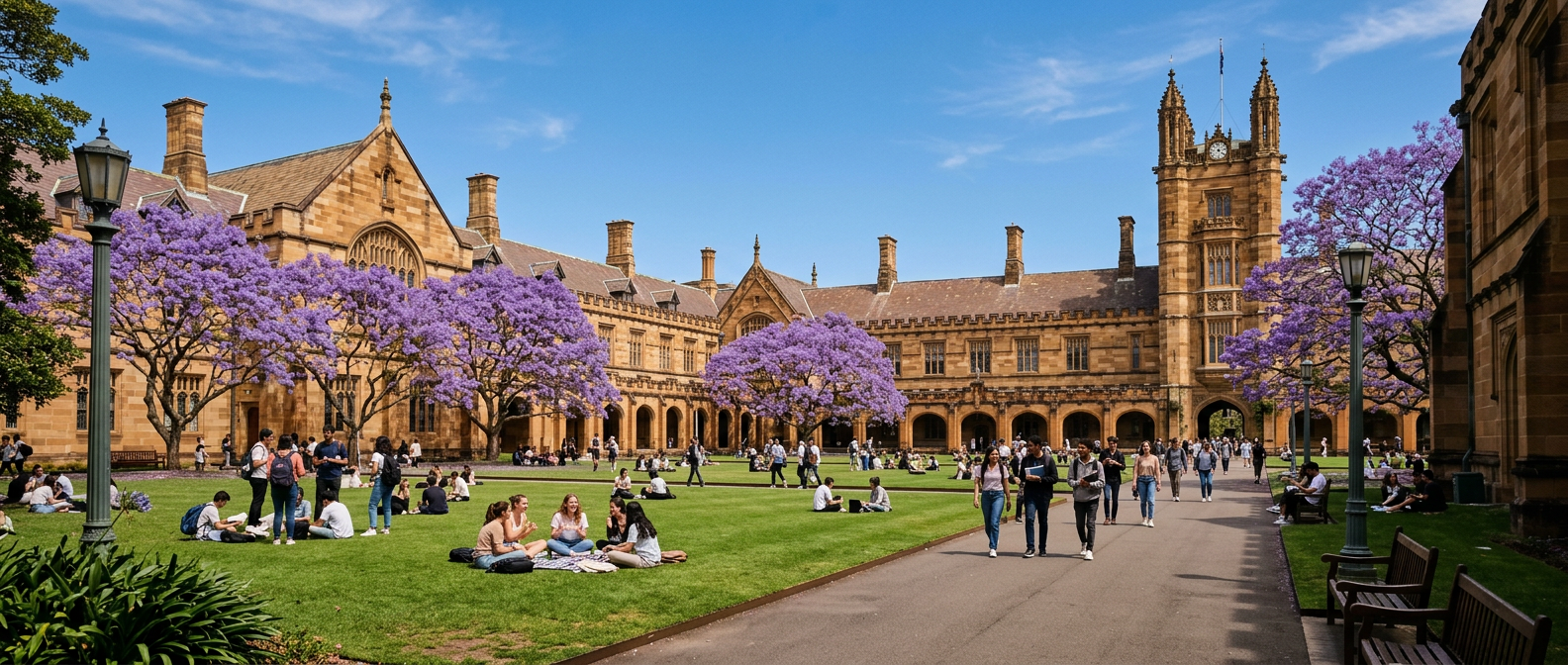
Take your family to Australia while you study.
Australia lets your spouse and children join you on your student visa. Your spouse can work, and graduates can stay on a post-study work visa. LEAPSAIL handles admission, your CoE and a subclass 500 file that meets the Genuine Student test.
What you pay to travel, and what you only show
Costs in Australia are counted in AUD. We separate the money you actually spend to travel from the proof of funds you show for the visa, which stays your own.
Your spouse and children can be included on your subclass 500 visa. Spouses of master’s students can work without hour limits.
Universities usually ask for your first semester’s tuition before they issue your Confirmation of Enrolment (CoE).
Show 12 months of living costs for everyone travelling, plus your remaining first-year tuition and travel costs.
About A$42,000 a year, before any scholarship.
Living costs: Home Affairs living cost (AUD 29,710 a year), plus AUD 10,394 for a spouse and AUD 4,449 per child.
Health: OSHC is compulsory for you and your family. Budgeted here for the first year. Family cover costs more than single.
Figures are indicative for 2026 and vary by school and city. We confirm your exact numbers during your assessment.
Shortlist up to three courses
Tap the courses that interest you, with how long each one usually runs, then send your shortlist to us on WhatsApp.
Pick up to three courses.
What Australia gives you
The reasons Nigerian students and families choose this route.
Family on one visa
Include your spouse and children on your student visa. Spouses of master’s students can work without hour limits.
Post-study work visa
The Temporary Graduate visa lets master’s graduates stay and work after their studies.
High student wages
Australia has some of the highest minimum wages in the world, and students can work 48 hours a fortnight.
Sun, safety and space
Relaxed cities, beaches and a high quality of life for you and your children.

Your family travels on the same visa.
Australia includes your spouse and children on your student visa. Your spouse can work, your children go to school, and graduates can stay on a post-study work visa.
- Spouse and children on your subclass 500
- Spouses of master’s students can work unlimited hours
- Post-study work visa for graduates
Strong wages
Earn some of the world’s highest part-time wages, up to 48 hours a fortnight in term.
School for your kids
Children can enrol in local schools while you study.
Stay and work
The Temporary Graduate visa lets you build Australian experience after you graduate.
Two ways to pay far less
We position your application for both routes, so you do not leave funding on the table.
University scholarships
10% – 50% off tuition
Most Australian universities discount tuition for strong international students, often for the whole degree.
- Often applied automatically at offer stage
- Discount usually lasts the full programme
- Higher grades unlock bigger cuts
Research Training Program
Full tuition + living stipend
The Research Training Program funds research master’s and PhD students with a tuition waiver and a living stipend.
- For research master’s and PhD students
- Includes a tax-free living stipend
- We help you approach supervisors
When to start
Scholarships and the best places go to early, complete applications. The right time to begin is now.
Start your process
We shortlist programmes and prepare your Genuine Student statement.
Apply to universities
Apply early for February or July. Discounts go to early applicants.
Deposit, OSHC & CoE
Accept your offer, pay your first semester and OSHC, then receive your CoE.
Visa & travel
Lodge your subclass 500 with your family and fly out for orientation.
Where you could study
A selection of Australian universities that admit Nigerian students and offer scholarships to international applicants.
Monash University
Top-ranked · huge programme range
University of Sydney
Historic · global reputation
University of Melbourne
Australia’s top-ranked university
UNSW Sydney
Engineering & technology
Deakin University
Employable · generous discounts
RMIT University
Design, IT & industry links
University of Adelaide
Research · lower living costs
Griffith University
Health & business
Curtin University
Mining, engineering & energy
What families ask us
Straight answers to the questions we hear most.
How much is the Australian student visa?
The subclass 500 main applicant fee is AUD 2,000, with extra charges for each family member you include.
What is the Genuine Student requirement?
You must show you intend to study, with a clear reason for your course and how it fits your career. We help you write this statement.
Your future in Australia starts with one message.
Book a free assessment on WhatsApp. A LEAPSAIL expert will map your course, your scholarship chances and your visa plan, then confirm our fee for your route.
LEAPSAIL is an independent educational and travel advisory consultancy and is not an embassy, consulate or government entity. Fees and thresholds are indicative and change; admission and visa decisions rest with the institutions and authorities.